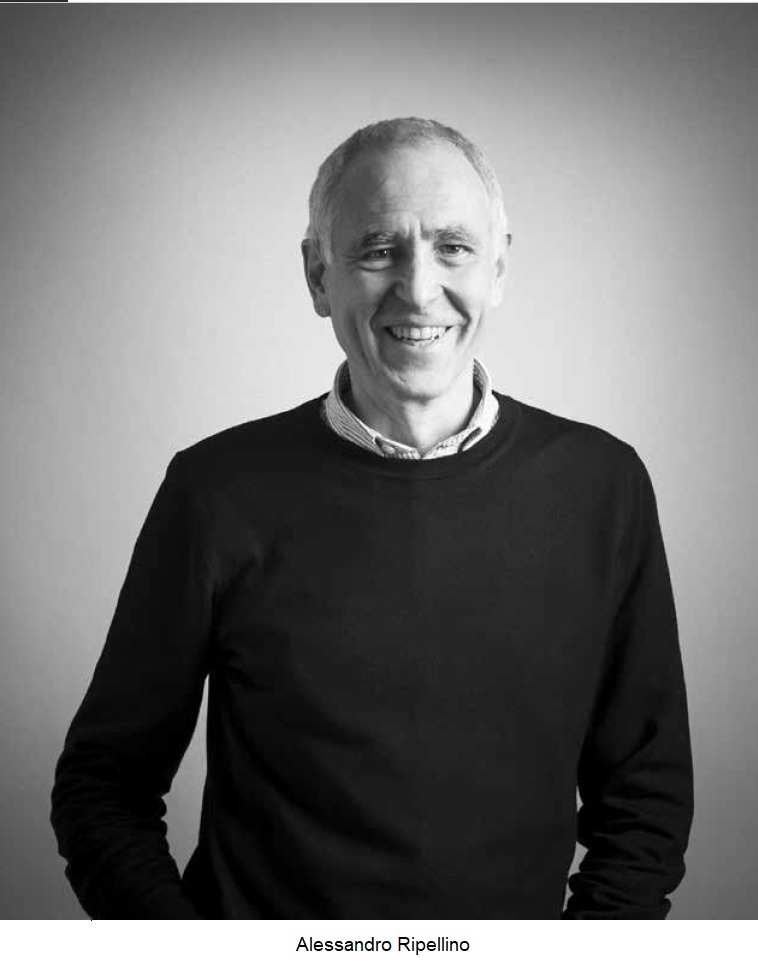
We meet Alessandro Ripellino, son of the great Slavist, prince of Bohemistics, poet and writer, on the centenary of his birth, fifty years after the publication of his masterpiece, Magic Prague
“Angelo Maria Ripellino, my father”
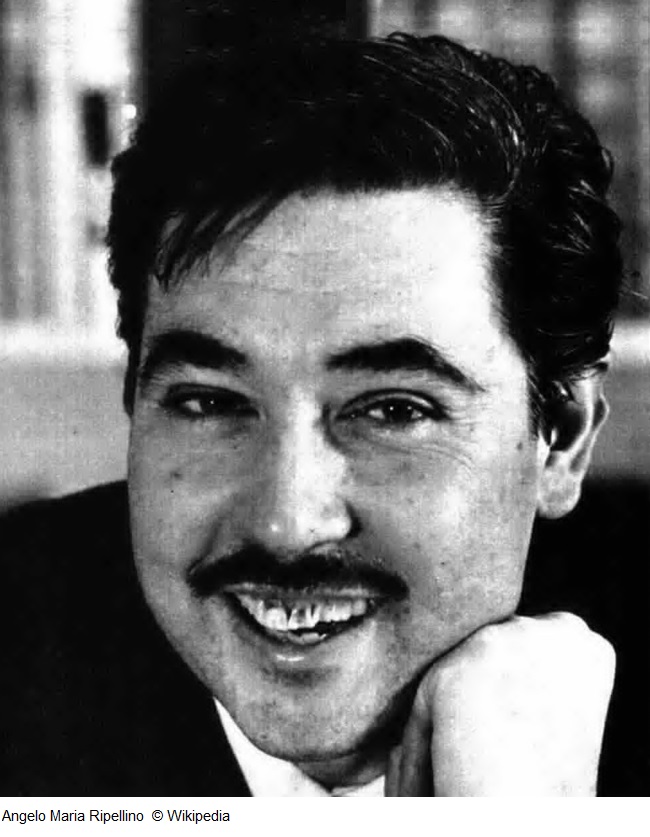
“Last week my grandson was born, and my daughter Giulia gave him the name Alvar Angelo Ripellino, in memory of the centenary of my father’s birth. For us it is an event that ties together three very different cultural situations in our family: my current one here in Stockholm, Prague, which we will talk about, and Rome.” In this manner we begin our conversation with architect Alessandro Ripellino, heir alongside his sister Milena to one of the most important voices of 20th century Italian culture. Born in Rome in 1957, Alessandro has been living for forty years in Sweden, where he has become an internationally renowned architect, the brain, among other things, behind the Swedish pavilion at the World Expo in Dubai. We catch up with him on the phone in Stockholm and immediately the emotion and enthusiasm in talking about his father and family is evident.
What is the first image that comes to your mind when talking about your father?
There are not so many images of a young child, but the strongest ones take me back to our summer trips to Bohemia, to when we stayed at Dobříš Castle, near Prague, where Czech, but also foreign writers were welcomed and also somewhat controlled. The castle, confiscated from the Colloredo Mansfeld family, was a mini Versailles, with its Italian-style garden, a river and a lake nearby. From that place I remember the light of the green meadows, which were unusual for me, as there were none of that colour in Italy in August. These are the images described in a verse by my father: ‘August: green glade light and the dog Bobina eating sugar cubes’, from the Sinfonietta collection. As a matter of fact, Bobina was the dog we children used to play with. This is my first memory. There is, however, another image that stands in contrast, almost as a counterpoint, and it is that of my Sicilian grandparents’ house in Rome, where we used to go for Sunday lunch. My grandfather, Carmelo Ripellino, was a teacher at the Liceo Classico Giulio Cesare and he too was interested in poetry, as he was in classical Italian literature.

Dobříš is also the place where your father spent a recovery period.
Yes, in 1964. I was very young then. In Italy there were still no appropriate medicines to treat tuberculosis and the Italian doctors, after having operated on him, told him that there was not much more they could do. So it happened that a friend of his, the Czech writer Jiří Fried, suggested he seek help in Czechoslovakia. They took him into the sanatorium in Dobříš, where he was hospitalised for over a year and managed to save his life. It was there that he wrote the ‘Auvergne’Fortress’ collection, where there is a very heavy image of snow, of the closing of this fortress that was actually the sanatorium. Of that time in Bohemia, I remember in particular the fog, the smell of coal that combined with that of the disinfectant used in the hospital in a strange mixture. It is these feelings as a child that are still part of me today.
Your father’s life was marked by illnesses. One of his former students remembers him like this: “with a shaky step, but always with a smile on his lips, albeit melancholic, but never downcast”.
Outside home he was always very outgoing, very positive, but at the same time very sweet. With his students he was not authoritarian but exuded a natural charisma. In the family, on the other hand, his concern was evident and in our eyes his image was certainly not reassuring. The final images I recall were of the great difficulties he had with his illness, the fear and anguish, but I also remember his will to fight. Until his final weeks, he continued to write his theatre criticism for L’Espresso.
You have also mentioned that in Dobříš you father was monitored
Intellectual guests were regularly spied on. Every time we entered our room, my father would lift a picture to see if there was a microphone, and most of the time there was. My father would throw it in the bin, cut the wires and after a few days it would reappear. All the guests in the castle knew it was like that, even joked about it, but everyone acted in such a way as not to talk too much, so as not to get into trouble. It was one of the aspects of the obtuse stupidity of that regime, with its absurd bureaucracy, part Hapsburg and largely Soviet, the mixture of two types of obtuseness, which hounded my family for a long time.
Let us move on to the fateful 21st of August 1968. You were just over ten years old.
Those were dramatic days. We were in Prague at the time, where my father also worked as a correspondent for Espresso magazine, reporting on the Prague Spring and Dubček’s new course. On the day of the invasion, they suggested we leave immediately. My mother Ela loaded the suitcases in the car, and we left in a hurry, towards Nuremberg. I remember the journey through the woods of Bohemia, on back roads, but where Warsaw Pact troops were already deployed. The anguish at the border controls was great, because they systematically opened the suitcases, and dismantled the seats. That time, however, they strangely let us through straight away.
Your father wrote Magic Prague when you were a teenager. What memories do you have of that period?
I remember that he worked with excerpts of ideas, which matured over a very long period, and this explains the long gestation of the work, as was the case also with some of his other works. He wrote with different coloured felt-tip pens, in order to follow these sequences of ideas. Then, with the help of my mother Ela, he would cut and recompose the collage. I am not sure when the idea of writing Magic Prague was born. The project for this essay-novel probably started around 1968, but the intention to talk about this melting pot of Yiddish, German and Bohemian culture certainly dates back to earlier, given the love my father felt for Prague from the very beginning.
What were your feelings about how that book would be received?
He was never the type to worry about whether something would be successful or not. So I don’t think he was very interested in either public or critical reactions. However, I remember well that it was Einaudi who imposed this title on him, Magic Prague, which made it appear simpler, and more touristy, than the more complex one my father would have liked.
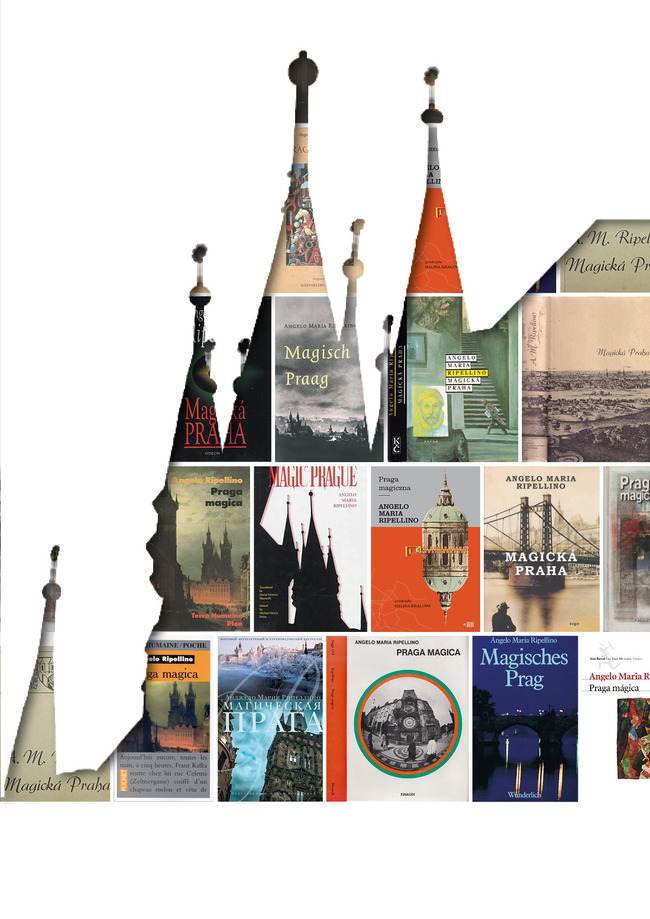
Leafing through the first edition of Magic Prague we learn that the photos are by a very young Alessandro Ripellino
Yes, it is true. My passion for photography has been linked, since I was a child, to the interest in art and the image that I received from my parents, and they indulged it. At the time of the photo shoot for Praga Magica, I was about fourteen years old, but I was already familiar with developing techniques and had a very good camera. In preparation for the book’s release, I went on a tour of the city with my parents, in autumn, early winter, so much so that you can see a few patches of snow. These photographs are somewhat reminiscent of Josef Sudek’s style and speak of a caliginous, grey, somewhat mystical and indeed magical Prague, in line with what was my father’s idea and commission. I used a very strong wide-angle lens, a fisheye, like the one used for the cover image. Regarding this last photo, unfortunately it was adjusted by Einaudi, who put in two colours that had absolutely nothing to do with it, also to make the book more touristy and commercial. I am sorry, however, that those photos do not appear in later editions, because they are very important for the book.
“I would also like to remember the role of my mother, Ela, who was of fundamental importance to my father’s work. Angelo and Ela lived and worked in symbiosis’.
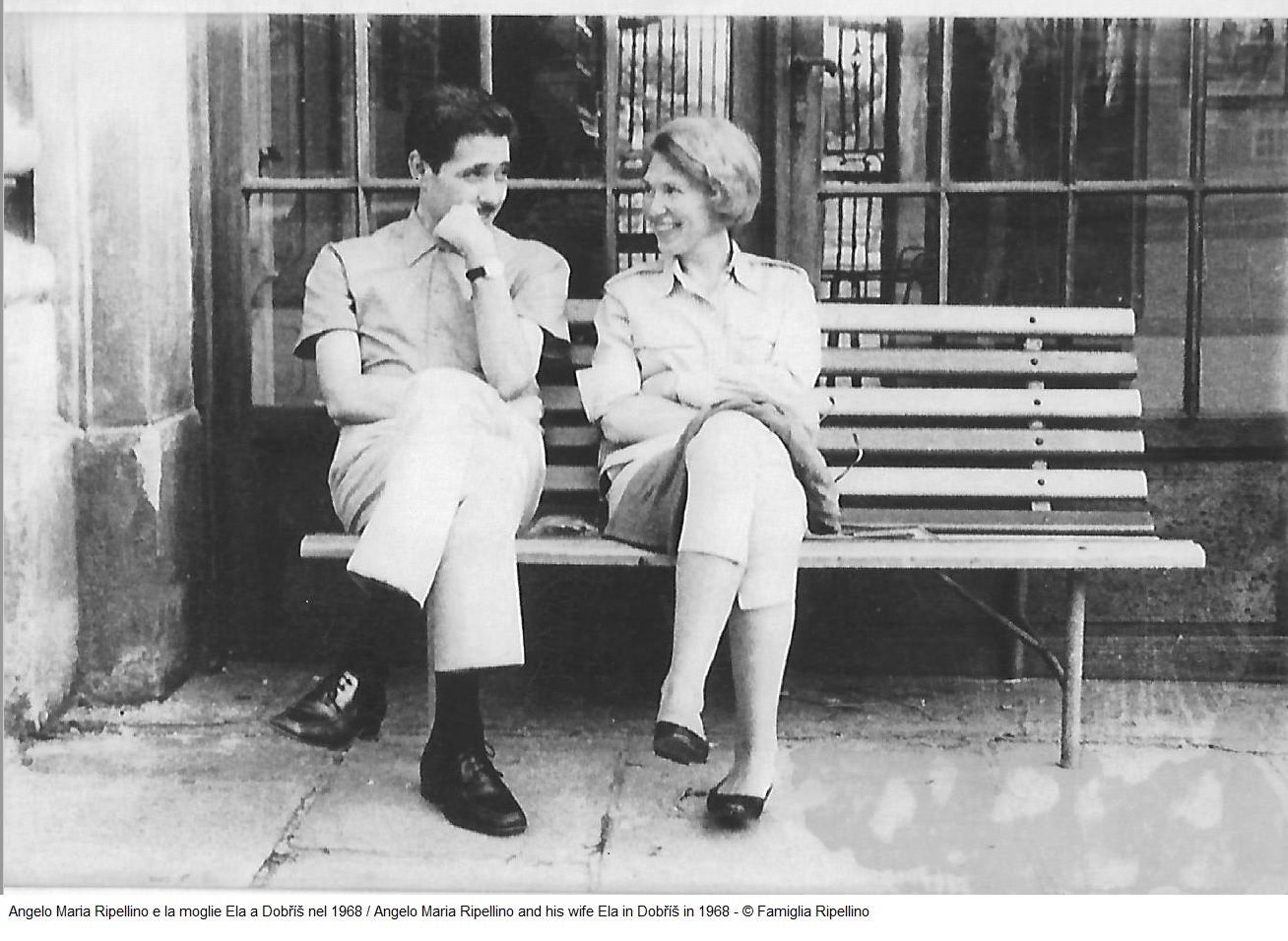
Let’s talk about your mother Ela. Italo Calvino coined the expression ‘Officina Ripellino’ to describe the contribution made to your father’s work
Ela was indeed fundamental to Angelo’s work, as an inspiration, but also a translator and even proof reader. She was a great help to him, thanks also to her knowledge, culture and poetical sensibility. Without Ela he would have been a different Angelo. They were genuinely a workshop; they lived and worked in symbiosis. She was an enthusiastic woman, very passionate, who remained dedicated to the Officina Ripellino until the last day of her life. They met in 1946 at the Italian Cultural Institute in Prague, which at that time was directed by Ettore Lo Gatto, of whom my father was a student. Angelo taught Italian literature courses, which my mother attended. The following year it was Ela who took the reverse route to join Angelo in Rome. She travelled alone, in her early twenties, in a Europe ravaged by war. She arrived in a Sicilian family with very different traditions for a woman from Central Europe, but that very strong love for my father allowed her to adapt. She was a very brave, fantastic woman.
What is your relationship today with your father’s works?
It is a very close relationship. Beyond Magic Prague, the works of my father to which I feel most attached are the poems, especially the first ones he wrote. ‘Not someday, but now’ is a collection, which I feel very deeply about. I find all the lexical richness in it, the presence of the image, of art, the linguistic nuances, this very complex, almost redundant, semantically complex imagery that characterised my father’s writings.
And what are the places in Prague that most bring you back in memory to your father and your family?
In general, all the places of Magic Prague, but in particular the Vltava and the island of Kampa, remind me of Vladimír Holan, the poet and writer whom my father translated and from whom he drew much inspiration. He had a very deep relationship with him. Holan was a very special figure. I remember us accompanying my father to the door of his house, on Kampa, near the mill, but the only one allowed in was my father. Then, on the other side of the river, Karoliny Světlé comes to mind. My mother came from a wealthy family and on Karoliny Světlé they had a beautiful house, which was confiscated in 1949. My grandmother, the babička, with a daughter who emigrated to a capitalist country like Italy and a son who refused to get the communist card, was sent to live in a small basement flat, practically a sub-basement, in the Smíchov district as a punishment. It was an incredible dwelling, where one entered through the bathroom and kitchen.
Alberto Arbasino wrote in 2014: ‘Poor Prague, from Kafka to money changer’. How would your father find himself in today’s Prague?
The sublimity of Prague is still there, no one can take it away, but I think my father would find it difficult to recapture the enchantment of the places, the grey and smoky atmosphere, that magic of those times. Today Prague, at least as I saw it five years ago, the last time I was there, is much more colourful, much renovated, but my father I think would be very saddened by the commercial globalisation, by the homologation whereby one finds in all parts of the world the same commercial boutiques, the same pseudo-consumerist culture. I certainly think he would suffer greatly from the trivialisation of this magical city.
So much has been said about the relationship your father had with Prague. I would like to ask you about what he had with Palermo, with Sicily, where he was born and spent his childhood.
He spoke very little about Sicily and I do not know why. Now that I too am more senior, I would be interested to better understand the feeling he had for his land. To this day I am still surprised that I have never heard him speak of Sicily’s blue sea, for example, which is of boundless beauty. I don’t really have anything to say. With the exception of Sunday lunch with his parents, he also had few relationships with other relatives. Yet Sicily is always present in his work, as is evident from his sensitivity to details: the smells, the scents, and above all the colours, especially yellow, which recurs in my father’s poems. Nor did he ever speak of the beauty of the Sicilian Baroque, and in particular that of Palermo, which he obviously knew well, and which certainly always remained in his eyes, a fundamental element of his education.
You are an internationally renowned architect. I would like to ask you if your father had an influence on your choice of professional life.
My father primarily passed on to me the audacity to choose my own path, even if it was different from his. Above all, he was a fantastic inspiration, because in my family all we talked about was literature, art, history and philosophy. Our house was a bit like a seaport, frequented by musicians, writers, painters, such as Piero Dorazio and Achille Perilli. I remember the intellectual discussions in the smoke of endless cigarettes, the dinners with literati and Italian friends, but also Czechs and Russians, the latter sometimes made a little too cheerful by how much they drank. It was a cultural humus that was also fertile in other areas, such as physics, a subject that has always interested me. It is probably no coincidence that my daughter has also become a particle physicist working at Cern, almost as if they were tracks that tangle and unravel in a complex web of family plots. I have to say, however, that my father barely knew my interest in architecture, as it arose in me during the latter part of his life.
To close, I would like a remembrance of your father, through the words of one of his poems.
I can only respond with probably his most famous lines: ‘To live is to stay awake… to live is to love life’.